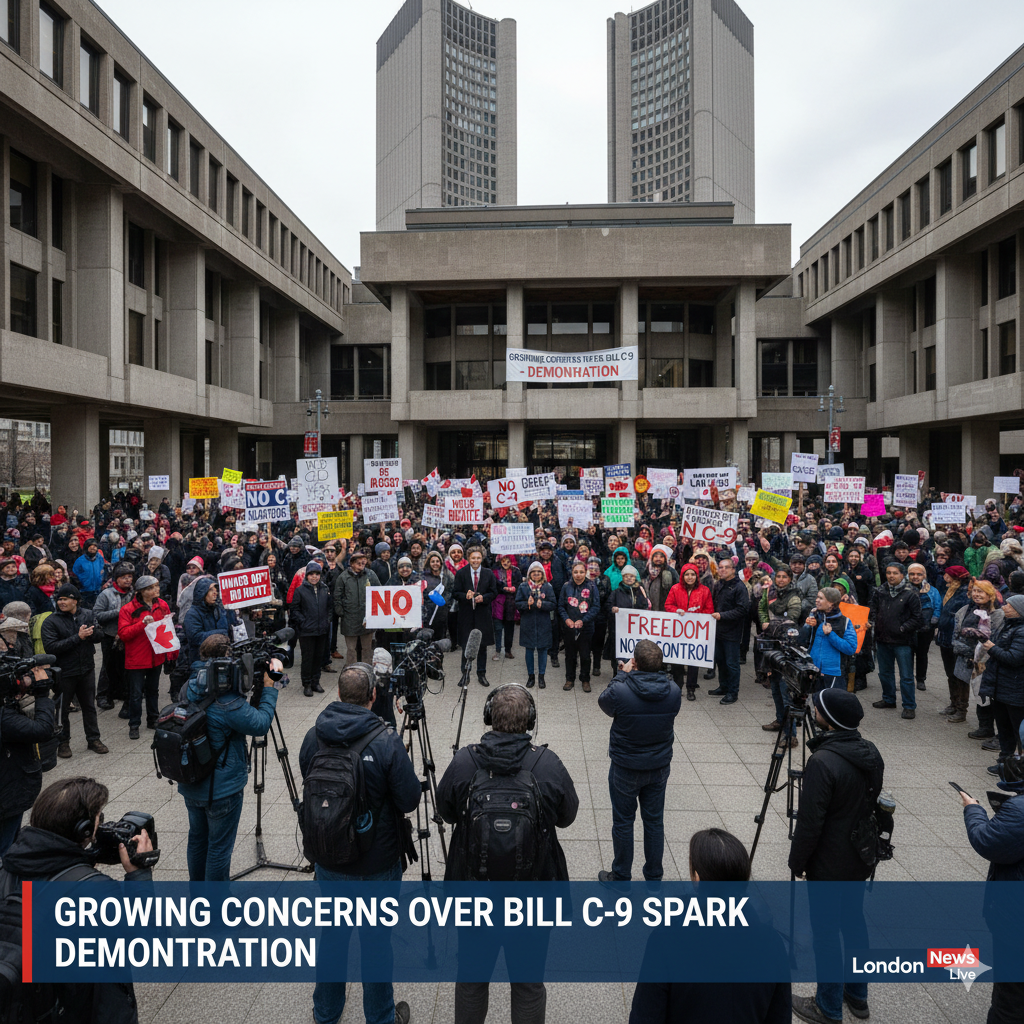
A diverse group of community members and advocacy organizations gathered outside London City Hall on Wednesday afternoon to express serious concerns about Bill C-9, the federal government’s proposed “Combatting Hate Act.” While the legislation is intended to strengthen protections against hate-related activity in Canada, critics fear its language and scope could have unintended consequences for civil liberties, protest rights, and freedom of expression.
The demonstration reflected a broader national debate around how to effectively combat hate while still upholding the democratic rights that form the foundation of Canadian society. Protesters emphasized that, although the goal of protecting communities from discrimination and violence is widely supported, the methods outlined in Bill C-9 raise troubling questions.
Public Concerns Focused on Civil Liberties and Oversight
Participants at the rally voiced apprehension about the potential erosion of established legal safeguards. One of the main points raised was that the proposed bill may reduce important layers of oversight that exist under current legislation.
Reem Sultan, a representative of the Canadian Muslim Public Affairs Council, explained that existing hate propaganda laws require the consent of a provincial attorney general before charges can move forward. According to her, this requirement serves as an important check in the justice system to ensure that prosecutions are fair, consistent, and not driven by political motives or social pressures.
“Bill C-9 undermines key legal protections that have long helped prevent discriminatory or politically motivated prosecutions,” Sultan said during the gathering. “Under current law, the requirement for attorney general approval acts as a safeguard. Removing that protection is a significant shift that could create serious risks.”
In her view, the bill would grant law enforcement broader authority and discretion in determining what constitutes criminal speech, without clearly defined boundaries. This, Sultan argued, may lead to inconsistencies in how the law is applied from one community to another.
Fears of Increased Police Discretion
A central concern shared by several speakers was that Bill C-9 could expand police powers without establishing clear standards for accountability. Critics believe that expanding discretionary authority while lowering the threshold for criminal charges could open the door to selective or unfair enforcement.
“Bill C-9 removes a layer of oversight at a time when parliament itself is now reconsidering some of its own decisions around civil rights and legal safeguards,” Sultan added. “The intent appears to be the expansion of unchecked discretion, something that should raise concern for all Canadians, regardless of background or belief.”
Participants stressed that any legislation dealing with hate speech must be carefully written to avoid targeting marginalized or racialized communities under broad or ambiguous definitions.
Concerns Raised by London’s Palestinian Community
Members of London’s Palestinian community were also present at the demonstration, and they strongly urged the federal government to withdraw the bill in its current form. Samah Al Sabbagh, president of the Canadian Palestinian Social Association, emphasized that the proposed legislation relies on vague and subjective definitions that could easily be misinterpreted or misused.
“Bill C-9 overreaches and relies on unclear language,” she stated. “It creates a new offense for displaying symbols linked to terrorism or hate, but it does not clearly define what those symbols are. That lack of clarity is alarming.”
Sabbagh explained that the absence of a clear, standardized definition of what constitutes a prohibited symbol could result in confusion, misinterpretation, and potential abuse. Symbols and imagery can carry different meanings depending on cultural, historical, and political contexts. Without precise definitions, individuals could be criminalized for acts that were never intended to promote hate or violence.
She further expressed concern that the bill could disproportionately impact racialized communities, activists, and political protesters, especially those advocating for international human rights causes.
“When laws are vague, they tend to be enforced against the most vulnerable,” she said. “This legislation risks creating a climate of fear, where people are afraid to express themselves or participate in activism because they are unsure of what might be deemed illegal.”
The Wider Implications for Protest and Free Speech
Beyond individual community impacts, protesters warned that Bill C-9 could have a chilling effect on freedom of expression in Canada. Several speakers pointed out that peaceful protest is a cornerstone of democracy and that legislation targeting speech must be carefully balanced to prevent overreach.
They noted that governments must distinguish clearly between genuine threats, incitement to violence, and legitimate political expression — even when that expression is uncomfortable or controversial.
Legal experts supportive of the protest argued that while hate speech laws are necessary in certain contexts, they must be narrowly crafted to avoid suppressing dissent. Broadly-worded laws, they said, risk being used to silence unpopular viewpoints rather than protecting vulnerable communities.
Jewish London Expresses Support for the Bill
Not everyone responding to Bill C-9 opposes it. In a statement provided to CTV News, Jewish London expressed clear support for the proposed legislation, emphasizing that it believes the bill offers meaningful protection without compromising freedom of expression.
“It provides real protection while fully respecting free expression,” the statement read. “We encourage parliamentarians of all parties to work together to deliver a strong and balanced approach that keeps communities safe.”
Supporters argue that enhanced legal tools are necessary at a time when hate-related incidents have increased in both frequency and severity. They view Bill C-9 as a step toward holding individuals accountable for spreading dangerous ideologies that can lead to real-world harm.
For those in favor of the legislation, the priority is sending a strong message that hate, intimidation, and extremist propaganda will not be tolerated in Canadian society.
A Nation Divided on the Path Forward
The demonstration at London City Hall highlighted a national divide over how to properly address hate without eroding democratic values. Both sides claim to be advocating for safer, more inclusive communities, yet they differ sharply on the approach needed to achieve that goal.
Those opposing Bill C-9 insist the government should revisit the draft and conduct broader consultations with civil liberty organizations, legal experts, and affected communities. They want stronger definitions, clearer limitations, and restored oversight before any new law is passed.
On the other hand, supporters believe delay risks allowing hate-motivated activity to grow unchecked. They argue that meaningful legal protection is necessary to prevent violence, intimidation, and long-term social harm.
Calls for Clarity and Consultation
Many of the protesters agreed that hate must be confronted firmly, but not at the expense of fundamental freedoms. Their primary demand is not the removal of protections for vulnerable groups, but the creation of carefully crafted laws that balance safety with rights.
Participants are calling on lawmakers to:
-
Clarify the definitions within the bill
-
Restore checks and balances in the charging process
-
Consult with a wider range of community and legal experts
-
Ensure that civil liberties and protest rights remain protected
They believe that taking the time to revise the bill properly will result in more effective, fair, and widely accepted legislation.
Conclusion: A Critical Moment for Canadian Democracy
The gathering outside London City Hall served as a clear reminder that legislation related to speech and public expression touches the very core of democracy. While the intention behind Bill C-9 may be rooted in the desire to protect communities from hate, the concerns raised show that many Canadians fear the cost may be too high if the bill is not carefully reconsidered.
As the federal government weighs its next steps, this growing public discourse underscores a vital truth: in a democratic society, safety and freedom must coexist. Any attempt to strengthen one should not come at the irreversible expense of the other.
The debate over Bill C-9 is far from over. For now, the voices raised in London represent a broader national call for transparency, balance, and the preservation of rights that generations have fought to protect.